Alison Bechdel is obsessed
with her relationship with her father and his death. In her memoir Fun Home she relates her
conviction that her father’s death was not an accident but premeditated suicide
opportunistically carried out with the help of a sunbeam truck. However Alison proves through her memoir to
be an unreliable narrator because of this the reader is left to conclude that
her father’s death was not suicide despite Alison’s firm conviction.
Beginning with the
overall structure of her memoir the reader will notice Alison’s convenient placement
of literary allusions. Throughout the
memoir Alison likens he father to Daedalus.
As Daedalus her father was constantly in motion creating and redesigning
“indifferent to the human cost of his projects” (11). While it is possible that her life did handily
line up with the stories of Icarus, Daedalus and Ulysses the seamless transition
from life to literary allusion leaves the reader feeling the transition was too
simple, too planned out. The reference
to her father as Daedalus continues until the last two pages of the
memoir. All this time she has convinced
her reader that her father is Daedalus but now to suit her literary intentions
she alludes to her father as Icarus. Alison
concludes that as Icarus was doomed to fall into the sea her father was doom to
commit suicide from the beginning. Alison
is a talented writer who is able to draw connections between two seemingly
unrelated topics but to do so it is very likely she tweaked events. Like her father’s transformation from Daedalus
to Icarus Alison may have customized events in order for the allusions and her
life story to flow more smoothly. This on
its own is not enough to call her father’s suicide an accident but it does
raise questions about her ability to convey an accurate story, as will the next
paragraph.
The most condemning
pieces of evidence as to why Alison is an unreliable narrator are provided by
Alison herself. Beginning on page 139
Alison’s father gives her a planner to recorder her day. She begins by chronicling events in a very
factual manner but by the next page she begins to doubt her recordings by
including “I think” in her journal entries.
She writes; “How did I know that the things I was writing were absolutely,
objectively true?”. (140) Alison
questions her ability as a narrator not in the panel which relates past event
but in the margin. This area is where
Alison includes most of her reflections on past events. For the reader this is one of the most solid pieces
of evidence that Alison is an unreliable narrator simply because she identifies
herself as one not in the panel but in the margin. The second instance of Alison being an unreliable
narrator centers on her period. Although
the event influences her description and interpretation of her years before
college Alison herself is unsure of the order of events. On the last page of the sixth chapter Alison
admits using the margin that she was “only estimating that this episode took
place in December. There is no mention
of it in my diary.”(186) Not knowing
when events occurred leaves events open to Alison’s reinterpretation for her
memoir. Like tweaking the story to fit her
literary allusions Alison may this time unwittingly be reinterpreting events.
Throughout her memoir
Alison provides the reader with enough reason to suspect she is an unreliable narrator. Both the transformation of her literary
allusions and her inability to remember the order of events leaves Alison’s
conclusions suspect. Was her father
really conspicuously “leaving A Happy Death around the house in what might be construed
as a deliberate manner”? (27) Alison
could not possibly have known this because according to her memoir she was a
way at college. Again the reader is confronted
by Alison’s haphazard story telling which leaves the reader wondering about her
reliability as a narrator. Moving on
from Alison unreliable narration it is impossible to take her seriously when
she concludes her father’s death was suicide.
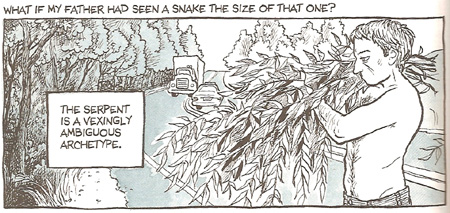
Everyone else in the memoir believes it was an accident. The snake her father saw was just a snake not
a fabrication as Alison would have her readers believe.

No comments:
Post a Comment