Saturday, June 15, 2013

Why Alison's father did not kill himself.


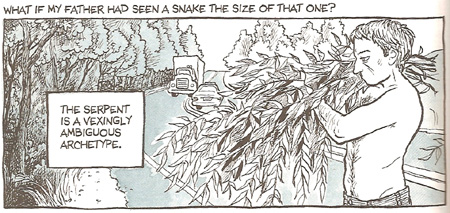
Alison Bechdel is obsessed with her relationship with her father and his death.  In her memoir Fun Home she relates her conviction that her father’s death was not an accident but premeditated suicide opportunistically carried out with the help of a sunbeam truck.  However Alison proves through her memoir to be an unreliable narrator because of this the reader is left to conclude that her father’s death was not suicide despite Alison’s firm conviction.

Beginning with the overall structure of her memoir the reader will notice Alison’s convenient placement of literary allusions.  Throughout the memoir Alison likens he father to Daedalus.  As Daedalus her father was constantly in motion creating and redesigning “indifferent to the human cost of his projects” (11).  While it is possible that her life did handily line up with the stories of Icarus, Daedalus and Ulysses the seamless transition from life to literary allusion leaves the reader feeling the transition was too simple, too planned out.  The reference to her father as Daedalus continues until the last two pages of the memoir.  All this time she has convinced her reader that her father is Daedalus but now to suit her literary intentions she alludes to her father as Icarus.  Alison concludes that as Icarus was doomed to fall into the sea her father was doom to commit suicide from the beginning.  Alison is a talented writer who is able to draw connections between two seemingly unrelated topics but to do so it is very likely she tweaked events.  Like her father’s transformation from Daedalus to Icarus Alison may have customized events in order for the allusions and her life story to flow more smoothly.  This on its own is not enough to call her father’s suicide an accident but it does raise questions about her ability to convey an accurate story, as will the next paragraph.

The most condemning pieces of evidence as to why Alison is an unreliable narrator are provided by Alison herself.  Beginning on page 139 Alison’s father gives her a planner to recorder her day.  She begins by chronicling events in a very factual manner but by the next page she begins to doubt her recordings by including “I think” in her journal entries.  She writes; “How did I know that the things I was writing were absolutely, objectively true?”. (140)  Alison questions her ability as a narrator not in the panel which relates past event but in the margin.  This area is where Alison includes most of her reflections on past events.  For the reader this is one of the most solid pieces of evidence that Alison is an unreliable narrator simply because she identifies herself as one not in the panel but in the margin.  The second instance of Alison being an unreliable narrator centers on her period.  Although the event influences her description and interpretation of her years before college Alison herself is unsure of the order of events.  On the last page of the sixth chapter Alison admits using the margin that she was “only estimating that this episode took place in December.  There is no mention of it in my diary.”(186)  Not knowing when events occurred leaves events open to Alison’s reinterpretation for her memoir.  Like tweaking the story to fit her literary allusions Alison may this time unwittingly be reinterpreting events. 


Throughout her memoir Alison provides the reader with enough reason to suspect she is an unreliable narrator.  Both the transformation of her literary allusions and her inability to remember the order of events leaves Alison’s conclusions suspect.  Was her father really conspicuously “leaving A Happy Death around the house in what might be construed as a deliberate manner”? (27)  Alison could not possibly have known this because according to her memoir she was a way at college.  Again the reader is confronted by Alison’s haphazard story telling which leaves the reader wondering about her reliability as a narrator.  Moving on from Alison unreliable narration it is impossible to take her seriously when she concludes her father’s death was suicide.  Everyone else in the memoir believes it was an accident.  The snake her father saw was just a snake not a fabrication as Alison would have her readers believe.
Friday, June 7, 2013


Loss of Faith and Search for the Chippewa Gods
Throughout the story Love Medicine is this feeling of a loss of faith in a higher power.  The people on the reservation do not pray to God for miracles and they do not attempt to worship Native gods.  Instead the people come to Lipsha a finite being and ask Lipsha to lay his healing hands on them.  It is because of the Native Americans collective loss of faith that Grandpa Kashpaw “embraces his second childhood”.(5)  Grandpa Kashpaw as a tribal chairman accepts the opportunity of otherworldly journey to seek the native gods for his tribe.

As a tribal chairman “who gave them bureaucrats what for” (5) Grandpa Kashpa would have been constantly thinking about what it means to be Native American.  He would have thought about the future and where the people were heading, the present what he could do for the tribe right now and the past the place he came from and the things that had been forgotten like Chippewa gods.  When he began to enter his second childhood Grandpa Kashpaw recognized it’s potential.  He could leave his physical body behind to represent the tribe in a mystical way.  This is why he says on the first page fifth paragraph, “I’ve been chosen for it.  I couldn’t say no.”  As a leader in his community it was impossible for Grandpa Kashpaw to pass up an opportunity to represent his tribe but where he was going and to whom he would represent his people was undisclosed even to him.
 
In the second paragraph on the third page Lipsha says he sees his grandfather “fishing in the middle of Matchimanito” Lake.  Interestingly this is the same lake on which the last sighting of a Native American god, the water monster Missepeshu, was said to have occurred.  Grandpa Kashpaw was waiting in the last place any of the spirits had been seen casting his line out looking for an answer to the big questions in life.  Lipsha thought he was casting his line in search of “bigger thoughts to, say, the meaning of how we go here”(18) but I do not think this true.  Grandpa Kashpaw was simply waiting symbolically in the middle of Matchimanito for someone to answer him.  Just like in the Catholic Church when he shouted HAIL MARY FULL OF GRACE Lipsha’s grandfather has made another attempt to be heard by a higher power.

The Chippewa people living on Grandpa Kashpaw’s reservation had lost faith in a higher power but still continued the rituals.  The people go to church praying to God who cannot hear them, making love potions and seeking mystical healing from a person who may be no more mystical than they are.  When presented with the opportunity Grandpa Kashpaw left his physical body behind in order to be hear by the higher power.  He went specifically to the Native gods to try and reconnect and restore his people faith with the former gods.  By doing so he also attempted to restore the tribe’s faith in its self through finding faith and purpose with a higher power.

Friday, May 31, 2013

Indian Education

Indian Education by Sherman Alexie is the story of a little boy growing as told through his progression through grade school.  In each grade the boy learns a different lesson about what it means to be different.  Interestingly his story not only reveals the difference between white and Indian but also between Indian and Indian.  As a disassociated member of each group the narrator is provided with a unique opportunity to provide insights into both.
For the reader it would be most obvious that the narrator was an outsider in white society from his earliest years of education.  Beginning with the ugly redheaded second grade teacher Betty Towle the narrator, Victor, was at odds with white authority.  It was not until high school that he begins to go with the flow of white conventionalism but that is not enough to make him an honorary member of white society.  Despite his apparent acceptance through scholastic achievement and basketball the narrator is still painfully aware that he is different.  While white girls force themselves to vomit in the bathroom and whisper nervously about anorexia the narrator and his family opened canned beef that even dogs wouldn’t eat and were happy to have food.  And it is not only the narrator who has not forgotten he is Indian the teachers also remember in the back of their mind intending to prevent him from spreading his bad Indian influence.  Like the teacher at the school dance.  The teacher knows all about those Indian kids and their drinking.  The narrator is part of this society and at the same time is not.  He is always evaluating the circumstances surrounding him and his actions in order to remain accepted by this group.
It may be more difficult for the reader to pick up on the divided between the narrator and his people but it began first.  It was in the first grade when the other Indian boys began to pick on the narrator.  The author writes “the other Indian boys chased me from one corner of the playground to the other …they stole my glasses and through them over my head … until someone tripped me and sent me falling again”.  Encounters like this were the beginning of the divided between the narrator and the other Indian boys.  As the children grew up there priorities diverged.  While the other boys remained on the reservation the narrator began attending high school in a farm town.  The narrator does not specifically state why he does this but it may have been at the encouragement of his fourth grade teacher Mr. Schluter.  By interacting and making friends with white society the narrator has solidified the divided between himself and the reservation.  In both the white high school and the reservation Victor the narrator is both a distant observer and a participant in events.  He interacts but is never truly trusted.  In the white high school he is accepted but no one ever forgets that narrator is different an Indian.  On the reservation he was initially ostracized because of his appearance, which may have been considered to white, and then later for willing choosing to interact with whites.

Friday, May 17, 2013


Pg52-53

While reading August Wilson’s The Piano Lesson I was struck by the hazy portrayal of the death of Bernice’s husband Crawley.  While reading this passage it becomes obvious that Boy Willie played a large role in the death of Crawley but the actual circumstances are unknown. The only other person present was Lymon, who at best is a simple and unreliable source of information and who at worst does not care to reveal the truth. Bernice seems to believe that Boy Willie I the direct cause of her husband’s death, not that he directly pulled the trigger but that he might as well have since he knowingly put her husband into a volatile situation. Even Crawleys killer is uncertain, the men knew that they were pilfering extra wood from what they were cutting, and if Crawley knew that they were stealing and knowingly brought a gun with him as Boy Willie claims then he knew what situation he was putting himself into. If that is the case then to say his death was Boy Willies fault would be unfair but if Boy Willie led Crawley to believe that the wood was his and that they had to move it before it was stolen, as Bernice claims, then he really could be seen as the reason for Crawley’s death.

Boy Willie is a straight forward kind of guy, to the point of being rude and abrasive. When he wants something he comes right out and says it. When he first arrives at Doaker and Bernieces’ residence he announces why he is there, and even explains why he wants the money, in great detail. He explains repeatedly to anyone who will listen how he intends to purchase the Sutter land and that the piano is doing Berniece no good just sitting in her front room. To his credit Boy Willie is not a liar, everything he says is true from his point of view, and as such I believe that he is a mostly reliable narrator. You must understand that everything he says may not happen exactly the way he says it did, but Boy Willie is not interested in embellishing the story. When he says that Crawley brought a gun with him to move the wood it is my humble opinion that Crawley did bring a gun and even have fired the first shot as Boy Willie tells it.

The entire tale is hinging on whether or not Crawley shot at someone he believed to be attempting to steal their already stolen wood, or if he shot at someone thinking the wood rightfully belonged to Lymon and Boy Willie. It really doesn’t even matter who killed him, it matters who Boy Willie led him to believe he was working against. There is also the looming question of who really shot Crawley.  Boy Willie has been truthful up until now, why would he start to lie now. The poor bereaved woman does not care who killed her husband, she cares that her brother talked her husband into doing something illegal, possibly by telling him it was legal and from her point of view got him killed. If Boy Willie is to be believed though Crawley was fully aware of the circumstances of the wood transportation, and that was why he brought the gun, and fired at their unknown antagonist. He may even have fired thinking to scare off the other men who had come to move the wood, either way it hardly matters to Berniece, she just wants her husband back and blames Boy Willie for his death.